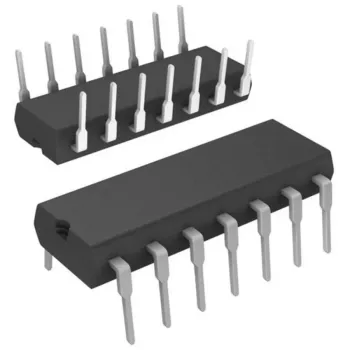
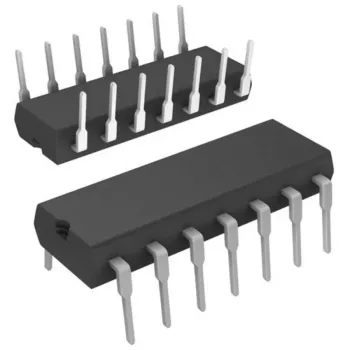
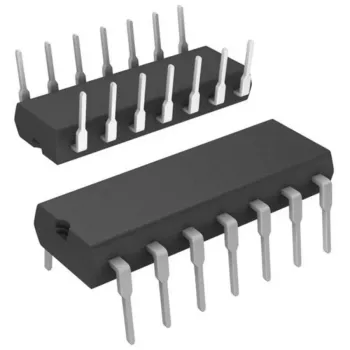
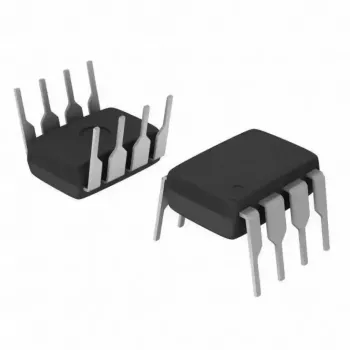
74HC164 DIP-14 Shift Register IC ⚙️
The 74HC164 is a high-speed, Si-gate CMOS 8-bit serial-in/parallel-out (SIPO) shift register in a DIP-14 through-hole package. Designed for low power consumption and wide supply compatibility, it’s ideal for expanding digital I/O lines in Arduino, Raspberry Pi, and other microcontroller-based projects and professional electronics systems.
Key Features ✅
- 8-bit serial input / parallel output for efficient I/O expansion
- Wide supply voltage: operates from 2 V to 6 V (compatible with 3.3 V and 5 V logic)
- High-speed clocking for rapid data shifting (datasheets often reference “ripple-carry” style clocking) ⚡
- Low power consumption thanks to CMOS technology 🔋
- JEDEC standard no. 7A compliant for logic family compatibility
- DIP-14 package for easy prototyping and breadboarding 🧪
Technical Specifications 📐
- Product Category: Shift Register
- Technology: CMOS (High-Speed Si-gate)
- Package: DIP-14 (through-hole)
- Operating Temperature Range: -40°C to +125°C 🌡️
- Supply Voltage Range: 2 V to 6 V
Typical Applications 🔧
- Serial-to-parallel data conversion for driving LEDs, relays, or general outputs
- Remote control holding registers and status latching
- Sequential timing circuits and digital sequencing
- High-frequency oscillator circuits and digital waveform generation
Integration with Arduino, Raspberry Pi, and Microcontrollers 🤖
This IC is a popular choice among electronics hobbyists and engineers for expanding GPIOs on Arduino, Raspberry Pi, ESP32, and other microcontroller platforms.
- 3.3 V systems (e.g., Raspberry Pi): Power the 74HC164 at 3.3 V for direct logic-level compatibility, or use level shifting if powered at 5 V.
- 5 V systems (e.g., Arduino Uno/Mega): Power the IC at 5 V for full-speed operation and standard TTL/CMOS interfacing.
- Minimal pin usage: Typically requires a data line, a clock line, and an optional reset (asynchronous clear) for robust control.
Design Notes and Tips 🧠
- The 74HC164 provides serial-in/parallel-out shifting; outputs update as bits are clocked in. If you require an output latch, consider pairing with a latch stage or using a device like the 74HC595.
- Use the asynchronous clear (active-low) to reset all outputs quickly at startup or during fault recovery.
- Cascading is straightforward: feed the last output into the next device’s serial input to extend beyond 8 bits.
- Observe voltage and timing constraints to ensure reliable high-speed operation, especially in longer chains or at lower supply voltages.
Whether you’re building a compact control panel, expanding GPIOs on a microcontroller, or prototyping with Arduino and Raspberry Pi, the 74HC164 DIP-14 shift register is a reliable, cost-effective electronics component for clean and scalable digital output expansion.